Fifa president proposes World Cup sell-off plan amid controversy

Fifa’s proposed sell-off plan
Fifa has announced plans to sell stakes in its football competitions, including the World Cup, to private investors. This proposal has been met with strong reactions from various stakeholders, including fans, politicians, and regional governing bodies. The organisation’s president, Gianni Infantino, has presented this initiative as a way to democratise football.
According to Infantino, the plan’s main benefit is a $40m funding package for all Fifa member countries to develop the sport once the deal is finalised. He has set a deadline of 19 September for football federations to accept the proposal to access an initial $20m. This move is considered one of the boldest by Infantino since he became Fifa president a decade ago.
The investment fund involved, Thrive Capital, is led by Josh Kushner, who is related to US President Donald Trump. Fifa has also engaged Greg Maffei, a former president of Formula 1 owner Liberty Media and a donor to Trump’s political campaigns, as a key commercial advisor. Infantino’s relationship with Trump has been highlighted, with instances including the creation of a Peace Prize awarded to Trump, the opening of a Fifa office in Trump Tower, and the display of the Club World Cup trophy in the Oval Office.
Support and opposition to the plan
Infantino appears to have sufficient support for the plan to proceed. Since his election in 2016, he has garnered backing from many countries in Africa, Asia, and the Americas, which have benefited financially from his policies. These policies include the expansion of the World Cup to 48 teams, an increase in commercial and broadcast revenue, and a programme that allocates millions in funding directly to member countries annually. This support base represents more than half of Fifa’s 211 members, and Fifa votes require a simple majority.
The proposal is particularly appealing to smaller football nations, for whom a significant financial windfall could exceed their usual earnings over several years. However, the plan has generated anger among some nations and regions who feel that discussions about the sell-off were conducted without their consultation. Uefa, the European governing body, has expressed strong opposition, stating that Fifa’s plan is designed to enrich itself and its associates.
Miguel Maduro, a former chairman of Fifa’s governance committee, has raised doubts about whether the allocated money reaches the intended levels of football development. He described Fifa’s system as a “political cartel” supported by patronage, and suggested that the proposal is likely to be approved, characterising it as a form of “legalised bribe.”
Infantino’s vision and ongoing conflicts
Infantino’s tenure has been marked by a consistent drive for expansion and increased revenue. Early in his presidency, he proposed expanding the World Cup and enhancing the Club World Cup. In 2018, he suggested a global Nations League, though this plan was later abandoned. The World Cup was confirmed to expand to 48 teams for the 2026 tournament, and plans for a biennial World Cup were announced in 2021.
More recently, there has been the launch of a 32-team Club World Cup, the awarding of the 2034 World Cup to Saudi Arabia without contest, and the spread of the 2030 World Cup across three continents and six host countries. Mandatory hydration breaks were also introduced at the end of last year without a member vote. These actions reflect Infantino’s consistent pursuit of growth and increased financial opportunities within football.
The proposed sell-off has intensified Infantino’s conflict with Uefa. Uefa President Aleksander Ceferin boycotted the World Cup final in protest of a decision to overturn a suspension, following a series of disagreements over issues like dynamic ticket pricing and hydration breaks. The revamped and expanded Club World Cup is also seen as a direct challenge to Uefa’s Champions League. Uefa members are reportedly angry about the plan, and a meeting is expected to be convened to discuss a response to Fifa’s proposals.
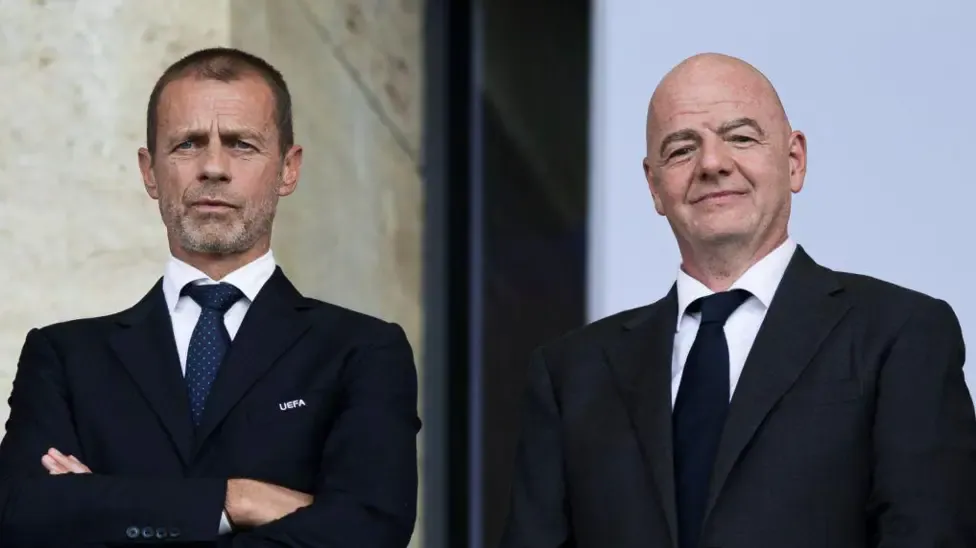
The specific nature of the latest plan has led to speculation that Infantino might be creating a lucrative role for himself after his presidency. Reports have suggested he could become CEO of the new venture, receiving remuneration comparable to a corporate leader. Fifa has denied such discussions, but the idea highlights the perception of his ambition. Infantino’s relationships with various world leaders, including Vladimir Putin, the emir of Qatar, the crown prince of Saudi Arabia, and Donald Trump, have been noted as part of his pursuit of status and power.
Source: bbc.co.uk

As NewsUK's Senior Football Correspondent, Thomas Beckwith reports on the Premier League, the EFL and the England national side for readers across the country. He reported on three World Cups for a national news agency. He holds a degree in Sports Journalism from Sheffield Hallam University and completed an NCTJ diploma. Thomas lives in Sheffield, where he watches lower-league football most weekends. “Football writing is about the decisions, not just the result.”